


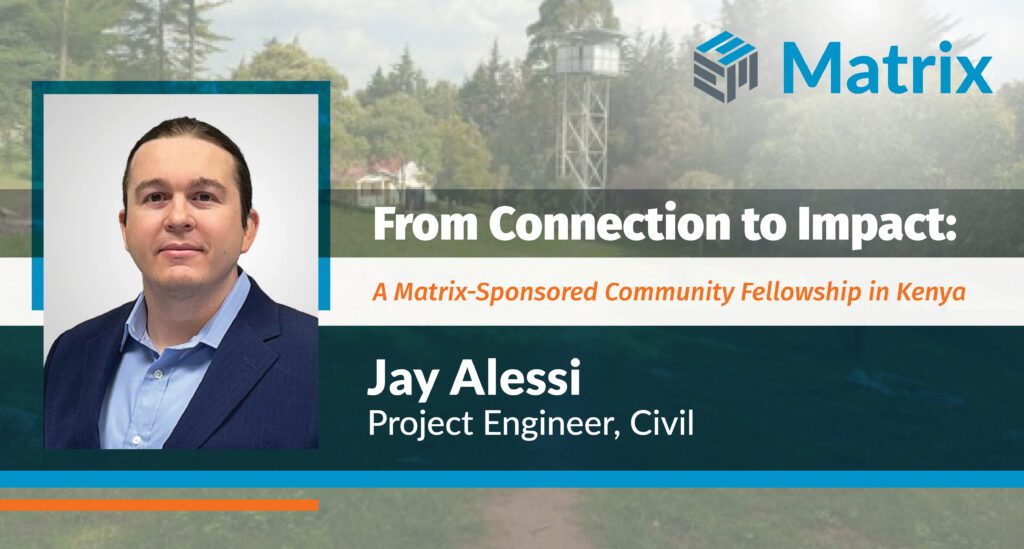
What started as a personal connection became a long-term commitment to a community working toward something fundamental: reliable access to water. In 2017, Jay Alessi, a civil project engineer at Matrix, with a background in community development and infrastructure, joined a high school friend to help a rural Kenyan community advance its water project through Engineers Without Borders–USA (EWB), supporting assessment, coordination, and implementation efforts.
“It didn’t start as a formal project. It was just trying to help where there was a real need. Over time, it became something I felt responsible to keep showing up for.”
That early involvement grew into years of continued engagement. In 2025, Jay was selected as a Matrix Community Fellowship recipient, supporting his ongoing work with EWB on the Kimaut Water Project, including a borehole implementation completed in early 2026. The Matrix-sponsored Community Fellowship program provides employees the opportunity to apply their expertise in real-world settings that support long-term, community-driven outcomes.
“One moment that stood out during my first visit was watching students line up after lunch to carefully wash their plates at an outdoor water tap. Each student would position their plate beneath another’s to capture as much water as possible—making the most of a limited resource.”
Even in the face of these challenges, the community was incredibly welcoming, and the kindness of the people left a lasting impression.
Why This Matters
Kimaut, Kenya is home to approximately 5,000 people across more than 800 households. Located in a mountainous agricultural region northeast of Kericho, the community depends on consistent access to water to sustain daily life.
When water is available, families can grow food, raise livestock, and generate income through crops like maize and coffee. Without it, those systems become unstable. Health risks increase, food supply becomes inconsistent, and children often spend time fetching water instead of attending school. Reliable access to water is not just an infrastructure issue. It directly affects long-term stability.
The Journey
The Kimaut community has developed over several years, shaped by on-the-ground experience, changing conditions, and continued collaboration. During his initial visit, the scale of need and the time required to address it became immediately clear, reinforcing that progress would depend on sustained engagement rather than a single solution.
Initial visits focused on understanding the community’s needs and existing water sources. That work expanded into mapping sub-villages, working with the local Water Committee, and identifying practical improvements. When travel paused during COVID-19, coordination shifted remotely, requiring consistent communication and trust with local partners to maintain progress.
More recently, efforts led by the Kericho County Government, including borehole drilling and expanded water storage, have improved both access and reliability. In early 2026, an additional borehole was implemented through EWB, building on that progress and increasing overall water capacity.
“There were points where progress felt slow, especially working remotely, but the relationships we built with the community and local partners kept things moving forward.”
The Impact
As access to water has improved, daily life in Kimaut has begun to shift in measurable ways. Women, who are primarily responsible for collecting water, are spending less time waiting in line or traveling long distances. In many cases, water no longer needs to be boiled before use, reducing both health risks and time burden.
Students are more consistently able to attend school rather than spending mornings fetching water. Households are better able to maintain small gardens during dry periods, supporting nutrition and overall well-being. Increased water availability has also supported livestock health and productivity, contributing to more stable food sources and income.
Economic opportunity is gradually improving, including the ability to cultivate crops like coffee with support from regional programs. While challenges remain, particularly around water access at schools, the progress made is both meaningful and ongoing.
Partnerships
This work reflects a collaborative effort between EWB, the Kericho County Government, and local partners, including Brighter Communities Worldwide. Progress has been built over time through shared investment, local leadership, and sustained coordination across organizations.
Looking Ahead
The 2026 borehole represents an important step, but not the endpoint. Ongoing efforts include improvements to existing water sources, expanded rainwater harvesting at schools, and potential collaboration on future borehole development to support the growing community.
“Seeing the progress over time, and knowing the community is driving it forward, has been the most rewarding part. It’s changed how I think about impact and what it really takes.”
Jay plans to remain involved as the project continues to evolve alongside the community’s needs.
“I will continue to support EWB projects, collaborate with other team members, and support the continued need for water within the community of Kimaut.”
For Jay, the experience has been both professionally and personally meaningful. Contributing to a long-term project like this has reinforced the importance of patience, partnership, and sustained commitment. It reflects the intent of the Matrix-sponsored Community Fellowship program: supporting sustained, community-driven impact.
#CommunityFellowship #GivingBack #EngineersWithoutBorders #MatrixGives