


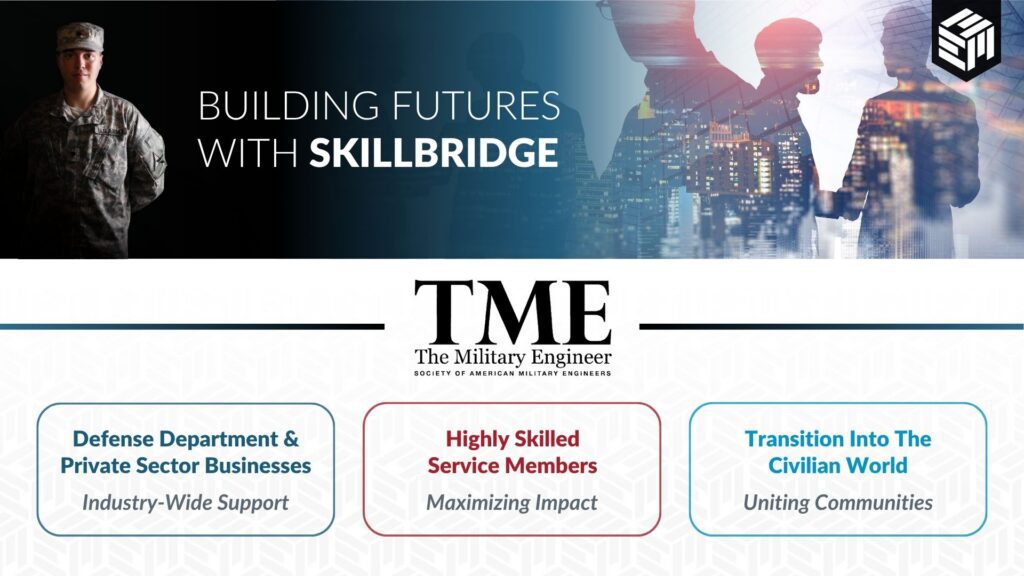
In today’s evolving workforce-landscape, the transition from military service to civilian employment is often one of the most critical inflection points a service member will face. That’s why the DoD SkillBridge program matters so much — it doesn’t only serve the individual; it serves our communities, industries and national readiness.
For our service members
- SkillBridge gives transitioning service members (during their final ~180 days of service) the opportunity to engage in internships, apprenticeships, and hands-on training in civilian industries aligned with their interests and skills. SAME+1
- Participants gain mentorship, meaningful project experience, exposure to civilian workplace culture — all of which help them translate military-honed leadership, decision-making and mission-focus into civilian career success. SAME
- Because the program allows the servicemember to “test drive” a career path while still under military status, it reduces the risk, uncertainty and anxiety typically associated with transition. For many, the result is not just a job—but a clear launchpad.
For employers, communities and the industrial base
- Employers benefit by gaining access to highly-motivated, disciplined talent who bring real experience in mission-oriented work, complex systems, leadership and adaptability. The SAME article emphasizes how “private-sector companies … gain access to world-class talent” through the program. SAME
- The arrangement removes financial risk for the host employer: salaries/benefits during the SkillBridge internship are covered by the DoD, allowing organizations to evaluate candidates without the usual overhead. SAME
- From a workforce-and-readiness perspective, the program helps fill critical talent gaps — especially in sectors tied to defense support, infrastructure, engineering, operations and sustainment. For example, the Army article highlights how SkillBridge is being utilized to bolster the workforce of Terminals, Depots, Arsenals, Activities & Plants (TDAAPs). Army.com
- On the community level, when transitioning service members find meaningful employment, the impacts ripple out—stronger local economies, fewer transition-related disruptions, and a deeper integration of service values into the civilian workforce.
What makes it effective
According to the SAME article, the most successful SkillBridge engagements share a few key attributes:
- Strong leadership commitment within the host organization — not just treating the program as a box-to-check but as a strategic pipeline. SAME
- Structured mentorship, meaningful project assignments, and onboarding that respects the unique experience (and transition needs) of the service member. SAME
- Flexibility: acknowledging that military-to-civilian transition isn’t just a change of job but a change of culture, style, and sometimes pace. Employers that adapt yield better outcomes. SAME
- A focus on alignment — matching the service member’s skills, interests, and goals with the host organization’s needs, rather than simply plugging someone into a generic role.
Why it matters now
With thousands of service members transitioning each year and with industries across the nation facing talent shortages (esp. in critical infrastructure, engineering, technology, defense-support roles), SkillBridge represents more than a “nice to have” program — it’s a strategic win-win. It bridges military experience and civilian opportunity, enhancing both individual prosperity and national strength.
In one sentence:
When done well, SkillBridge turns what could be a challenging transition into a strategic opportunity—for service members launching the next chapter, for employers tapping exceptional talent, and for communities and our national infrastructure benefitting from a seamless flow of mission-driven professionals.