


Turning Priorities into Projects
In the first article in our wildfire resilience series, we explored the importance of planning before a wildfire occurs: understanding risk, identifying vulnerabilities, and establishing priorities that can help communities and watersheds prepare for what comes next.
But identifying priorities is only the beginning. The next challenge is turning those priorities into projects that can be designed, funded, and built.
Moving from planning to implementation can be complex. Wildfire does not follow jurisdictional boundaries, and resilience projects often involve multiple stakeholders, infrastructure systems, landowners, and agencies. Advancing projects requires determining what is feasible, building the right coalition, and developing solutions that respond to conditions on the ground.
From Priority to Project | One of the first requirements for implementation is a project champion: an individual, stakeholder, or organization that takes ownership, builds momentum, and rallies others around the effort.
A strong project champion is particularly important because wildfire resilience involves such a varied group of stakeholders. They help engage those interests, build consensus around priorities, communicate the need for action, and develop the broader coalition needed to advance projects.
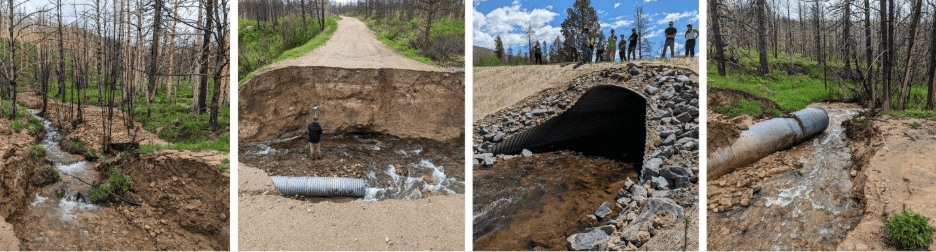
Road stream crossings become incredibly vulnerable in post fire watersheds. Quick and efficient collaboration and project execution leads to resilient crossings which are vital for wildfire affected communities.
“Often, an organization becomes the champion that helps move an initiative forward. Larger organizations can bring additional influence and momentum, and water providers have a significant interest because of the potential impacts to watersheds, water quality, infrastructure, and long-term water supply,” said Mason Haycock, Senior Water Resources Engineer, Matrix Design Group. “Bringing those stakeholders together around shared goals helps create a path from identifying risk to advancing projects.”
From there, the shared goals generally lead to two general types of projects:
- Traditional infrastructure improvement, including increasing bridge and culvert capacity, protecting water and wastewater systems, and improving stormwater infrastructure.
- Natural infrastructure restoration and preservation, including forest management, stream restoration, and preservation of healthy stream corridors that can improve the ability of natural systems to withstand and recover from disturbance.
Feasibility then helps determine what can realistically move forward. Property ownership, access, environmental conditions, technical requirements, cost, and jurisdictional responsibilities can all influence whether a project advances as originally envisioned or needs to change.
Designing for Resilience | Resilience is not about preventing natural systems from changing. It is about strengthening their ability to withstand disturbance, adapt, and ultimately recover.
That distinction becomes important during design. A project may involve engineered infrastructure designed to better withstand wildfire-related impacts, natural infrastructure intended to improve watershed function, or a combination of the two. The appropriate solution depends on the risk, existing conditions, and the project’s broader objectives.
Healthy stream systems, for example, can play an important role in watershed resilience. As a keystone species, beavers directly influence the form and function of these stream systems. Their dams slow and spread water across the landscape, helping retain water, support wetlands, reduce the energy of stream flows, and create habitat. These wetter, more connected areas are better positioned to withstand disturbance and recover afterward. Changes in beaver populations or the loss of dams, however, can alter those conditions and affect stream stability. Designing for resilience means understanding these natural processes and considering not only how a system responds to disturbance, but how effectively it can recover and continue to function.
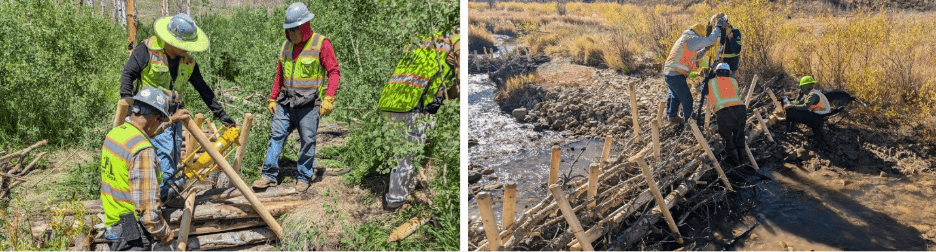
Close cooperation with construction crews leads to high quality and resilient Low-Tech, Process Based Restoration structures. These in stream Post Assisted Log Structures trap post fire sediment, protecting downstream water quality.
“Projects don’t necessarily need to happen sequentially. You may have a transportation agency upsizing roadway infrastructure while an environmental organization is advancing ecological improvements within the same watershed,” said Drew Beck, P.E., Executive Director, Water & Environment Division, Matrix Design Group. “The key is coordinating those efforts so stakeholders understand how the projects interact and how they can work together to support the larger resilience objective.”
Natural infrastructure can also have a lower barrier to entry than major capital improvements allowing some projects to move forward while larger infrastructure investments progress through longer funding, design, and construction processes. This parallel approach can build momentum while advancing resilience across multiple fronts.
Getting Projects Built | Funding remains one of the biggest barriers to implementation, particularly when financial capacity varies significantly among stakeholders. State and federal grants can help, but matching requirements may put funding out of reach for a single organization. Building a coalition allows partners to combine resources and pursue opportunities that might otherwise be unattainable.
Matrix Design Group works with clients to identify additional funding sources and connect projects with grant support and expertise across the company.
As projects advance, the larger objective needs to remain in focus. Individual solutions may change as constraints emerge, but decisions should continue to support the priorities and resilience goals established at the outset.
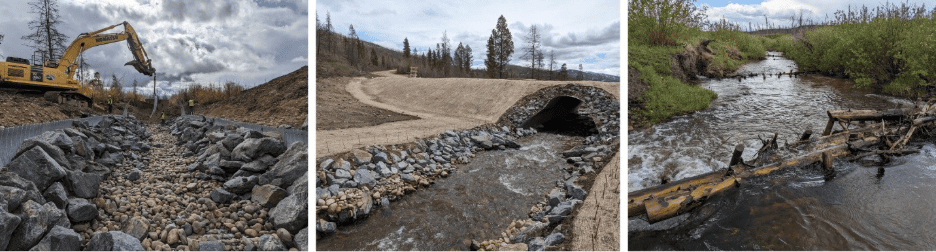
After the wildfire, the work begins. Watershed wide improvements are required to gradually repair the damage from the floods after the fire.
Measuring Success and Building Long-Term Resilience | Clear goals and metrics provide a consistent way to evaluate progress, guide conversations with stakeholders, and determine whether a project is achieving its intended outcomes.
“Defining what success looks like from the beginning gives us something tangible to work toward. As projects evolve, those goals and metrics help us evaluate whether we are still achieving the larger resilience objective,” added Haycock.
The results can also extend well beyond the original project objective. Natural infrastructure that helps attenuate flows and trap sediment may also improve habitat, support healthier stream systems, retain water, and provide other ecological and community benefits.
“That’s one of the opportunities with resilience. When we improve the way a natural system responds to disturbance, we’re often creating multiple benefits at the same time. Those benefits can also bring together people and organizations that may have different interests but ultimately share a stake in a healthier, more resilient watershed,” said Beck.
Ultimately, wildfire resilience is about more than preparing for the next fire. It is about creating infrastructure and natural systems that can withstand disruption, recover, and continue to serve the communities that depend on them.
Planning establishes the path. Design and implementation turn that vision into lasting resilience.
In the final article in our wildfire resilience series, we’ll look at these strategies in action through projects designed to strengthen watersheds, infrastructure, and long-term resilience.
#WildfireResilience #WatershedResilience #NaturalInfrastructure #CommunityResilience